
Mozambique's Wild Coast: An Adventure Guide to Pomene
Mozambique's wild coast, the honest version: diving, fishing, whales, nesting turtles, mangroves and the 4×4 sand track into Pomene, with seasons, effort levels and what to bring.

A quick correction before anything else. The Wild Coast proper is in South Africa's Eastern Cape. Mozambique's wild coast isn't a place on a map. It's what people call the stretches of Mozambique's coastline that are still hard to get to, with no resort strip and no tar road to the beach.
Pomene is one of those stretches. This guide uses it as the worked example. For each adventure you get the season, how much effort it takes, and what you need to bring or book.
What makes this coast wild?
Mostly, the road. Pomene sits inside the Pomene National Reserve, which Mozambique's conservation authority ANAC lists as established in 1964. It has vegetated dunes, savannah, mangroves and swamp on the land side, and reef off the beach. There's no town and no shop. The last stretch in is sand.
That track filters people out. On an ordinary morning you'll share a long white beach with ghost crabs and perhaps one fisherman. It's quieter than Tofo or Vilankulo because it's less convenient. Nobody planned it that way.
One honest exception: MSC calls at Pomene Bay during the South African cruise season, roughly late November to early April. On those days the bay is busy for a few hours. Check the sailing dates against yours.
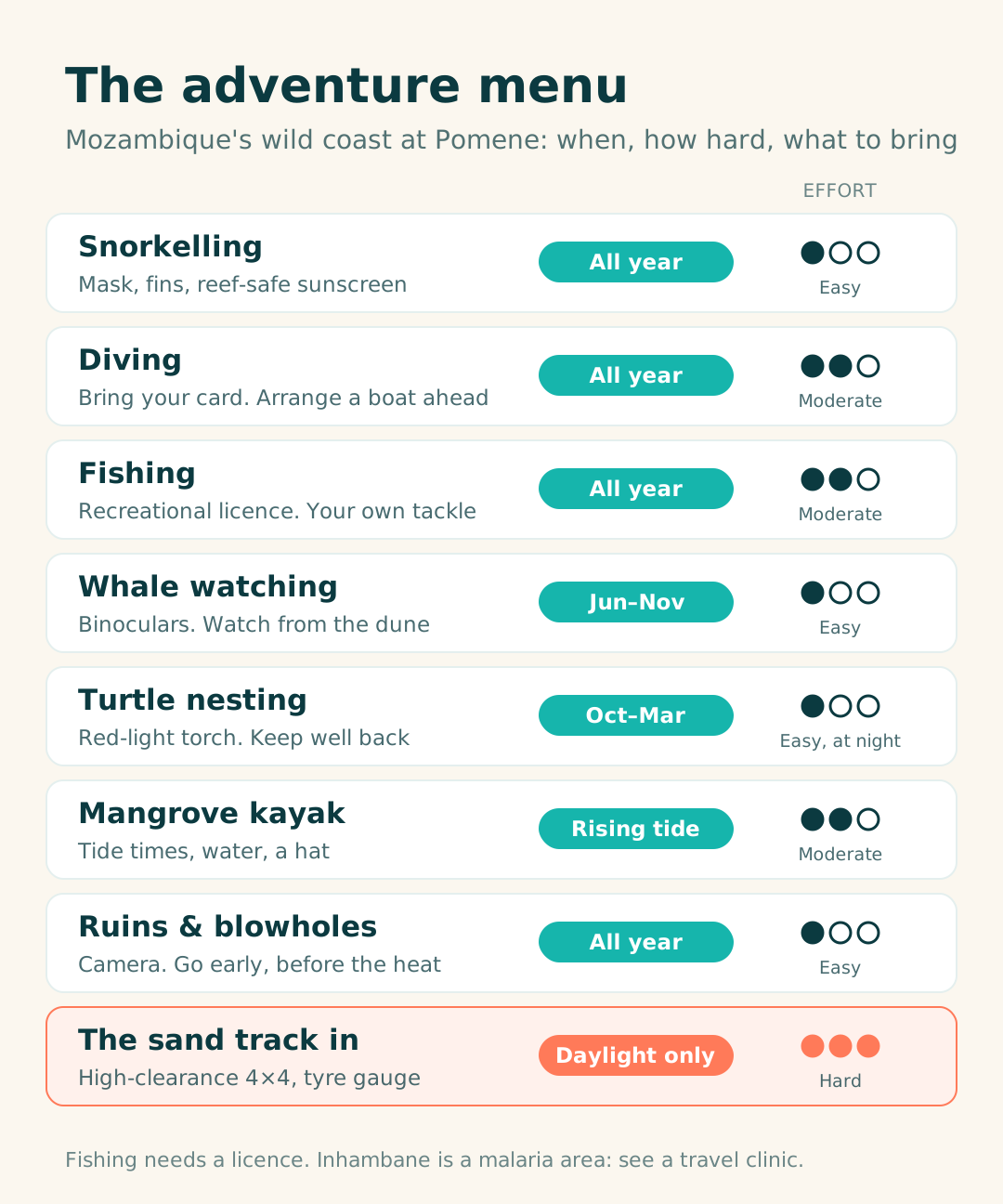
1. Dive and snorkel the reef
The reef starts close to shore, and the water is warm all year. Snorkellers can wade in and swim out. You'll see coral, shoals of reef fish and, often, a green turtle grazing.
Diving in Mozambique this far from a town needs planning. Pomene has no walk-in dive shop, so message us before you travel and we'll tell you what boats are running. Bring your card. Our diving and snorkelling guide covers sites, tides and gear.
2. Fish the reef and the open water
Pomene has been known for reef and game fishing for decades. Many families first came here for it.
Rules first. Fishing in Mozambique needs a recreational licence, for visitors as well as locals, under Decree 82/2021. Charter skippers normally handle it for you. If you're casting from the beach with your own rod, sort it out before you arrive. You're also inside a reserve, so ask about any local limits.
The upside of self-catering: whatever you land is dinner.
3. Whales and turtles
Humpback whales travel a recognised migration corridor along this coast from roughly June to November. You don't always need a boat. From the dune, watch for the blow first, then the tail. See our whale watching guide.
Loggerhead turtles, with the odd leatherback, nest on the beach from October to March, the season recorded in southern Mozambique. Walk the tideline at night with a red light, keep well back, and never get between a turtle and the sea. Our turtle nesting guide explains how.
4. Beyond the beach
Behind the peninsula is a wide estuary edged with mangroves. Kayak it on a rising tide, when the water runs clear and the birds are feeding. ANAC lists flamingos and pelicans in the reserve.
On the point stand the ruins of the Hotel de Pomene, a colonial hotel from 1963 that was abandoned during the civil war years. Go early with a camera, before the heat. Nearby, when a swell is running, the sea booms through the blowholes. Keep well back from the edge, because the rock is wet and the surge is strong.
5. Going off-grid
Our lodge runs on solar power. Signal is patchy, and there's no reliable Wi-Fi. For the first day that feels like a problem. By the third it's the best part. There's almost no artificial light for kilometres, so the night sky is the real thing.
6. The 4×4 route in
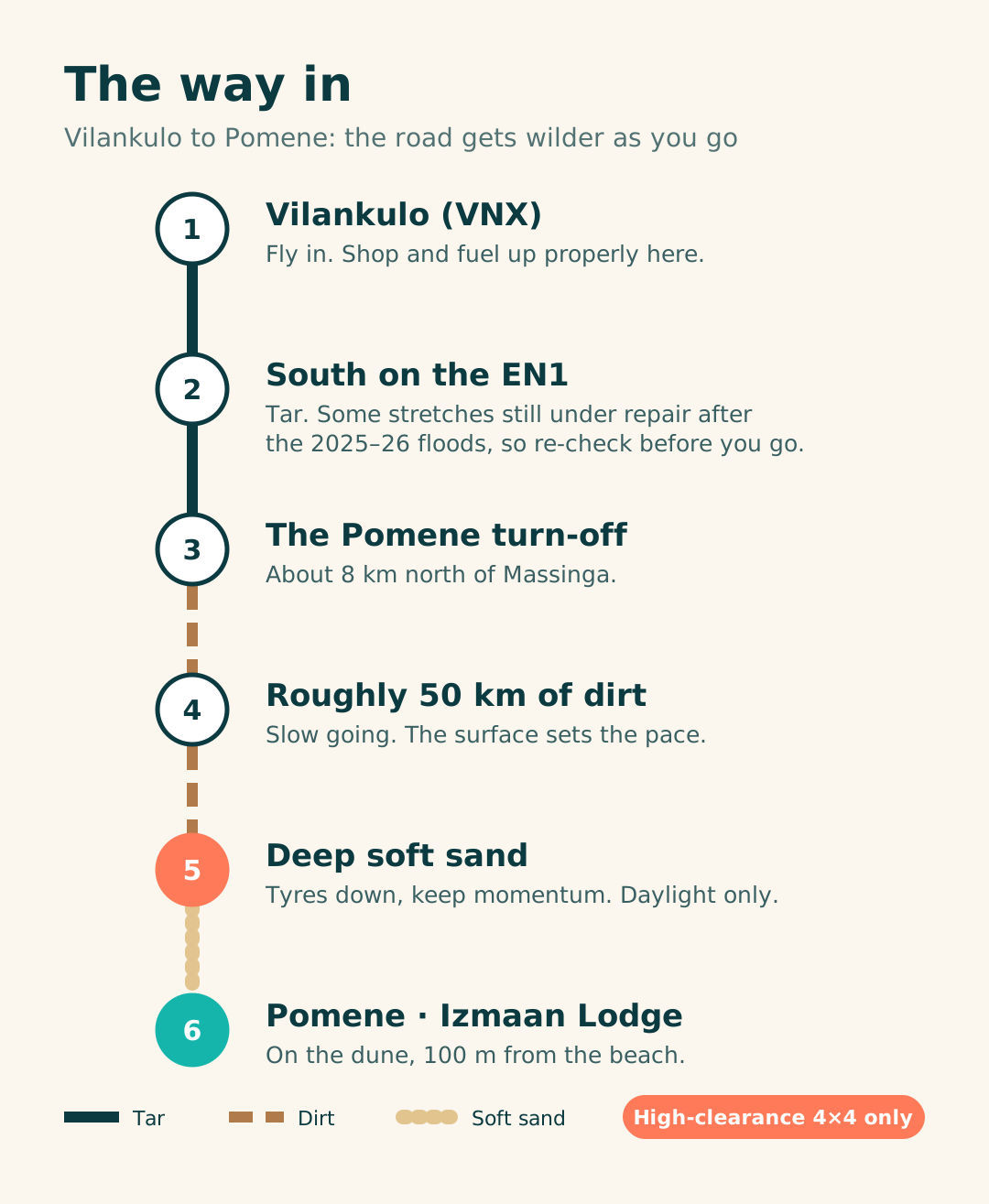
Most people fly into Vilankulo (VNX) and drive south on the EN1. Others come up by road from South Africa through the Komatipoort border. The Pomene turn-off is about 8 km north of Massinga. Then comes roughly 50 km of dirt, ending in deep soft sand.
You need a high-clearance 4×4. Let your tyres down before the sand, keep your momentum, and never arrive after dark. Some EN1 stretches are still being repaired after the 2025–26 floods, so re-check the route before you set off. Our 4×4 guide covers tyre pressures.
It's slow. It's also why the beach is empty when you get there.
Adventure, or a long nap?
You don't have to do any of this. Plenty of guests fish at dawn and then don't move from the deck until sunset. A wild-coast holiday means you get to choose, not that you need a plan for every day.
When to go
| Months | Best for |
|---|---|
| May–Sep | Cooler, drier days for walking and exploring |
| Jun–Nov | Humpback whales |
| Oct–Mar | Turtle nesting |
| Nov–Mar | Warmest water, but hot and humid |
| All year | Fishing, diving, snorkelling |
Inhambane is a malaria area, so see a travel clinic before you travel. More detail in the best time to visit Pomene.
What to pack
Reef-safe sunscreen, a hat, a head torch with a red-light setting, insect repellent, your own snorkel and mask, binoculars, personal medication, a tyre gauge and compressor, and every grocery for the stay. There's no supermarket in Pomene, so do your last big shop before the turn-off.
Who it won't suit
Anyone after nightlife, shops, restaurants, constant internet or an easy drive. That's the honest trade.
Your base on the dune
Izmaan Lodge sits on the dune about 100 m from the beach. It has two timber-and-thatch units with four en-suite bedrooms between them, a full kitchen and a deck facing the sea. It's self-catering first. Half-board and all-inclusive are available with two weeks' notice. Couples can take one unit; groups can book the whole lodge for up to eight.
You come back sandy and salty, cook what you caught, and watch for whales from the deck.
Ready to see Mozambique beyond the usual tourist trail? Message us on WhatsApp with your dates and what you're driving. We'll tell you what's in season and give you an honest read on the road.
Frequently asked questions
Is Mozambique good for adventure travel?+
Yes, if your idea of adventure is the sea and the bush rather than theme parks. The coast offers reef diving and snorkelling, reef and game fishing, humpback whales from June to November and nesting turtles from October to March, and places like Pomene still need a 4×4 to reach.
Is the Wild Coast in Mozambique?+
No. The Wild Coast is a named region in South Africa's Eastern Cape. Travellers use "Mozambique's wild coast" loosely for the country's less developed shoreline, such as the Pomene reserve in Inhambane Province.
Do you need a fishing licence in Mozambique?+
Yes. Recreational and sport fishing in Mozambican waters needs a licence, for foreign visitors as well as locals. Charter operators usually arrange it for you; if you fish on your own, sort it out before you cast.
When is whale watching season in Mozambique?+
Humpback whales pass along the southern Mozambique coast from roughly June to November. At Pomene you can often see them from the dune without going out on a boat.
When is turtle nesting season in Pomene?+
October to March, mainly loggerheads with the occasional leatherback. Hatchlings start emerging from around late December. Watch from a distance and use red light only.
Do you need a 4x4 to reach Pomene?+
Yes. The last stretch into the Pomene reserve is dirt and then deep, soft sand. You need a high-clearance 4×4 and should lower your tyre pressures before the sand.
Planning a trip to Pomene?
We'll help you plan every step — the drive, the dates, the season.